


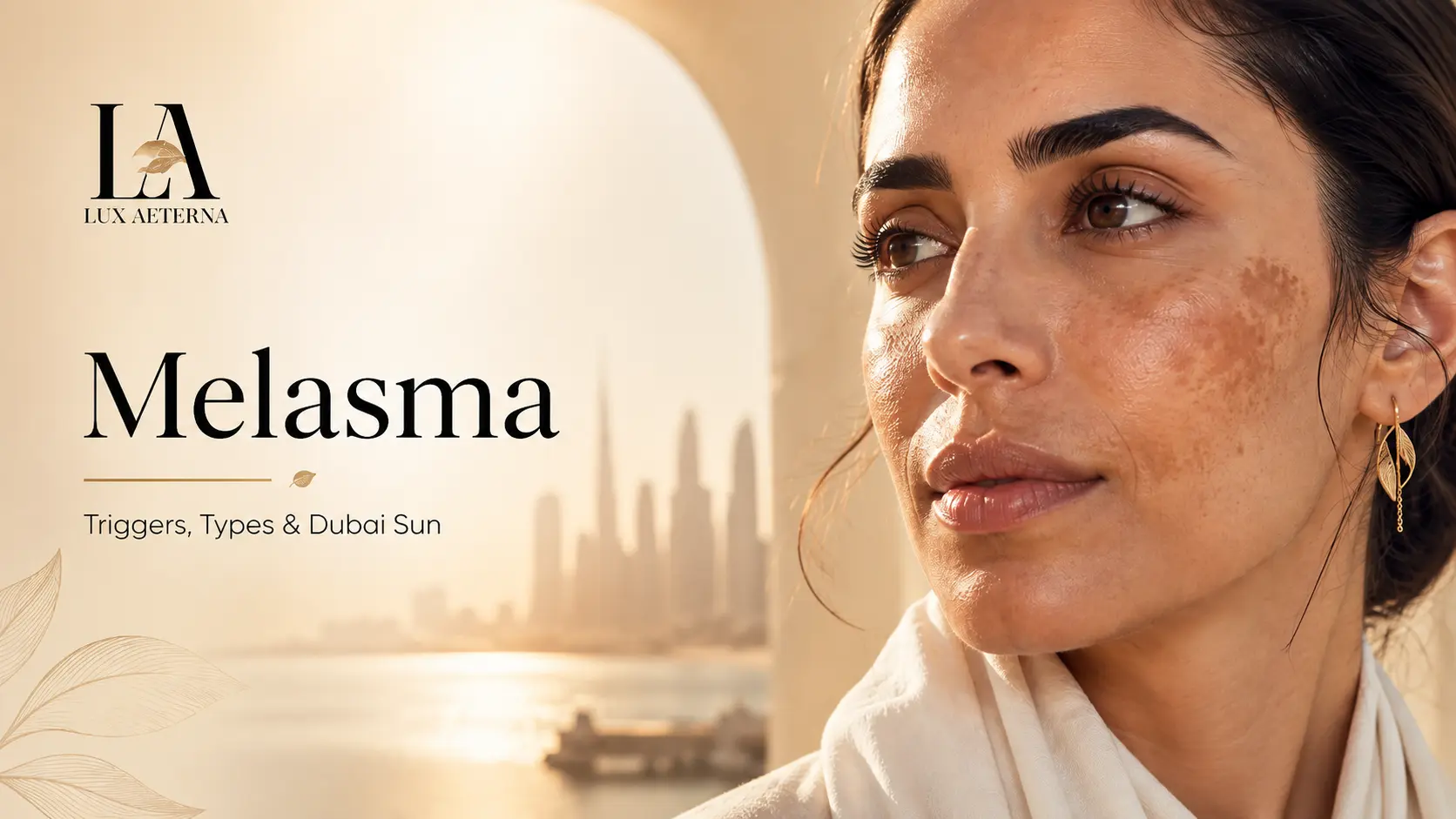
Brownish patches showing up on your cheeks, forehead, or that spot right above your lip, and they’re not going anywhere no matter what you try? There’s a good chance you’re looking at melasma, not just regular sun damage. It’s one of the most common things we see walk through the door here, and also one of the most misunderstood. So let’s actually get into what causes it and why Dubai, specifically, seems to make it worse than most places. If you want a broader look at how skin concerns get assessed in this climate overall, our guide on Skin Health and Dermatology Care covers that in more detail.
What Melasma Actually Is
Basically, certain cells in your skin start pumping out way more melanin than usual, and it lands in patches, almost always mirrored on both sides of your face. Most people call it a sun spot or leftover acne mark at first glance, which, fair enough, but it’s not either of those. Cheeks, forehead, that bridge of the nose area, chin, sometimes right above the lip, patches range from tan to properly dark brown, occasionally with a bit of gray mixed in depending on your natural skin tone.
Women get it a lot more than men do. And it leans heavily toward people with medium to deeper skin tones, which, if you look around Dubai, is basically most of the city. That’s part of why it comes up in consultations here so much more than it might somewhere with a lighter-skinned, cooler-climate population.
The Main Triggers Behind Melasma
Sun exposure tops the list, and it’s not close. UV rays flip a switch in those pigment-producing cells, and if you’re already someone prone to melasma, even a quick walk without sunscreen can darken a patch or start a new one. Here’s where Dubai doesn’t do you any favors. There’s no real break from the sun, it’s strong nearly year round, so the trigger just never really shuts off. That’s the reason melasma here often outlasts and outstubborns what you’d see somewhere with an actual cold season.
Hormones are the other big piece. Pregnancy is famous for setting it off, enough that people nicknamed it the “mask of pregnancy” ages ago. Birth control and hormone therapy can trigger it too, since estrogen and progesterone both seem to nudge the skin toward producing more pigment than usual.
Heat doesn’t get nearly enough credit as a trigger on its own. Some research points to heat, separate from UV entirely, making melasma worse, which is a real problem in a city where it’s regularly in the high 30s and 40s for half the year. Genetics matters as well. If it runs in your family, you’re more likely to get it yourself, sometimes even with fairly mild sun exposure compared to what it takes to trigger someone else.
Certain skincare habits can stir things up too, particularly anything that irritates the skin or leaves it more sun-sensitive without proper sunscreen backing it up afterward.
The Different Types of Melasma
Melasma sits at different depths depending on the person, and that’s honestly most of why treatment plans end up looking so different from one patient to the next.
- Epidermal melasma stays closer to the surface, edges a bit more defined, and generally responds better to topical brightening work
- Dermal melasma goes deeper, tends to look more blue-gray than brown, and takes longer to shift since products applied on top just can’t reach that far down
- Mixed melasma is a bit of both, which honestly is what we end up seeing most often walk through the door, and it usually calls for a layered approach rather than pinning hopes on one single treatment
Getting the type right actually matters. Treat dermal melasma like it’s the surface kind, or the other way round, and you’ll mostly just end up frustrated a few months in with nothing to show for it.
Why Melasma Keeps Coming Back, and Why Consistency Beats the Treatment Itself
Melasma’s got a reputation for being difficult, and it’s earned that fairly. Most pigmentation fades eventually on its own. Melasma doesn’t play by that rule, it tends to creep back the moment sun exposure isn’t kept in check. Which is exactly why sunscreen stops being optional the second melasma’s involved. It’s not a nice extra step, it’s the whole game. Broad spectrum, reapplied properly, worn daily, even on the days you’re barely leaving the house, since UV still comes through car windows and office glass more than most people assume.
Treatment tends to work better as a combination rather than betting everything on one product or one procedure. Topical options gradually lighten existing pigment over time. For deeper or more stubborn patches, in-office treatments often get added into the mix. HIFU treatment sometimes comes up as part of a broader skin health plan, since it supports firmness and overall skin condition, though it’s worth being upfront that it isn’t a direct melasma treatment on its own, more something that works alongside pigmentation-focused care depending on what else is going on with your skin. A proper melasma treatment in JLT usually starts by figuring out exactly which type you’re dealing with and how deep it sits before anything gets recommended.
One thing our practitioners always factor in is how nearby treatments interact with active melasma. Laser hair removal, for instance, is completely fine for most people and remains one of our most requested treatments, but if melasma is active in a nearby area, we simply adjust settings and timing during your consultation so it works safely alongside your pigmentation care rather than against it. That’s really just part of doing a proper assessment, not a reason to avoid it altogether.
Getting an Accurate Read on Your Skin
Honestly, melasma’s one of the easier things to misread on your own. It can look a lot like sun damage or old acne marks, depending on your skin tone and even just the lighting you’re standing under when you check the mirror. If those patches have been hanging around for months, or they’re quietly getting darker no matter what you throw at them, that’s your sign to get an actual professional look rather than keep guessing with products. A wellness clinic in Dubai that does proper skin analysis can tell you exactly what type you’re dealing with and build something around that, instead of you trying five different creams and hoping one sticks.
Frequently Asked Questions
Does melasma ever fade on its own?
Sometimes, yeah, particularly if it showed up because of pregnancy or a short stretch of hormone therapy. Once that trigger’s gone, it can settle down by itself. But for most people dealing with constant sun exposure, especially living somewhere like Dubai, it tends to stick unless someone’s actively managing it.
Can men get melasma?
They can, it’s just a lot less common. Shows up the same way, sun-triggered patches on the face, but men often go longer without getting it properly diagnosed since it’s not usually on their radar as something to check for.
Does melasma come back after treatment?
It can, mostly if sun protection slips afterward. That’s really the whole story behind melasma’s stubborn reputation, it’s not that the treatments fail, it’s that the trigger needs managing long after the skin looks better.
Can I still get facials or other treatments if I have melasma?
Usually, yes. Just depends on the treatment and how active the melasma is right now. That’s the whole point of a proper consultation first, so whoever’s treating you can adjust things instead of accidentally stirring it up further.
This article is for general informational purposes only and isn’t a substitute for professional medical advice. Melasma can vary significantly from person to person, and a qualified practitioner should assess your skin before recommending any treatment.