


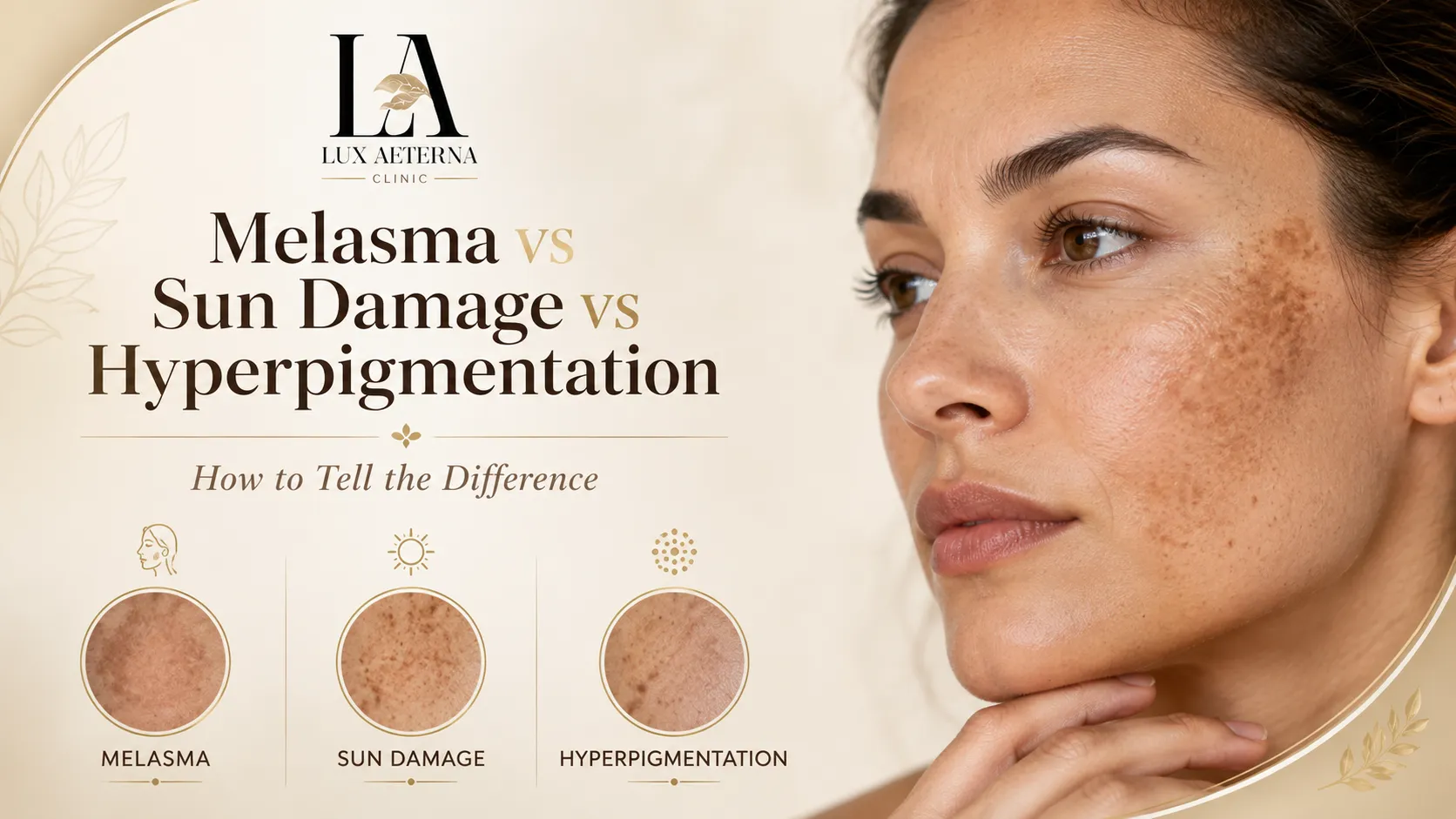
Dark patch on your face that wasn’t there a year ago? Chances are you’ve already searched a few possibilities, melasma, sun spots, hyperpigmentation, and ended up more confused than when you started. Fair enough, honestly, because these three overlap a lot on the surface. They’re not the same thing though, and treating one like it’s another usually wastes months. Here’s how to actually tell them apart.
Why People Mix These Up So Often
All three show up as unwanted discoloration. All three get worse with sun exposure. And early on, before anyone’s really looked at them properly, they can genuinely pass for one another. Same brownish tone, same general location on the face, same reaction of why is this darker than last month. The only real way to tell them apart is looking closely, where exactly it sits, what shape it takes, and what was actually going on when it first showed up.
Sun Damage: The Straightforward One
Sun damage, or solar lentigines if you want the technical term, is honestly the easiest of the three to explain. Years of sun exposure wear on the skin, and eventually the cells responsible for pigment start overproducing in the areas that took the most hits, cheekbones, forehead, hands, shoulders, wherever sun lands most often.
A couple of things give it away. The spots are usually scattered with no particular pattern, sharper at the edges, smaller in size, and they build up slowly over years rather than showing up out of nowhere. Hormones have basically nothing to do with it. It’s a UV story from start to finish, which explains why it’s everywhere in a place like Dubai where the sun barely takes a break.
Melasma: The Hormonal, Symmetrical One
Melasma plays by a different set of rules, and once you’ve seen the pattern, it’s not hard to recognize again. It shows up symmetrically almost every time, mirrored patches across both cheeks or spread over the forehead, not the random scattering you get with sun damage. The edges are softer too, less of a defined spot, more of a hazy patch that blends into the skin around it. And the real tell is hormones. Sun damage doesn’t respond to them at all, but melasma flares up with pregnancy, birth control, hormone therapy, situations that leave regular sun spots completely unaffected.
It also moves faster. A trigger can bring melasma on within weeks, nothing like the slow, years-long buildup that sun damage needs. Want the full picture on what drives it and why it’s such a common complaint in this particular city? We’ve covered that in more depth in our guide on melasma treatment in Dubai.
Post-Inflammatory Hyperpigmentation: The One With a Backstory
This one’s different from the other two for a simple reason, there’s always a clear event behind it. Acne, a cut, a burn, even an overly aggressive facial or a bug bite, once skin heals from any kind of injury or inflammation, it can leave behind a flat, discolored patch right where the damage happened. That’s post-inflammatory hyperpigmentation, and honestly, the easiest way to spot it is that you can usually point to exactly what caused it and roughly when it started.
Unlike melasma, it isn’t symmetrical and doesn’t follow a hormonal pattern. Unlike sun damage, it’s not purely UV driven, though sun exposure can definitely make an existing mark darker and slower to fade. It also tends to actually improve over time on its own, something melasma rarely does without active management.
A Quick Way to Compare Them
Trying to keep all three straight in your head? Here’s the short version.
In terms of pattern, sun damage lands wherever the sun’s hit hardest, no real order to it. Melasma sticks to that mirrored, symmetrical look across both sides of the face. Hyperpigmentation just marks the exact spot where something happened, an old breakout, a healed cut, nothing random about it.
As for what causes each, sun damage is purely a years-of-UV story. Melasma’s driven by hormones and made worse by sun. Hyperpigmentation traces back to one specific injury or inflamed spot on the skin.
Timing tells its own story too. Sun damage creeps in slowly, over years. Melasma can show up within weeks once triggered. Hyperpigmentation appears almost right after the skin finishes healing from whatever caused it.
And if you’re wondering whether any of these just go away by themselves, sun damage usually won’t without help, melasma almost never fades without consistent management, but hyperpigmentation often does clear up on its own, just given enough time.
Why the Difference Actually Matters for Treatment
Here’s the part that trips people up the most. What works well for one of these can do very little, or occasionally even backfire, on another. Melasma is notorious for getting worse with treatments that are too aggressive or heat-based, since irritation can trigger a fresh wave of pigment production. Sun damage generally responds better to more direct approaches since there’s no hormonal component fighting against the treatment. Hyperpigmentation often just needs time plus the right topical support, without necessarily needing anything intensive at all.
This is exactly why guessing at home rarely goes well. Something like SkinPen microneedling can be genuinely useful for texture and some types of pigmentation, but it needs to be approached differently depending on which of these three you’re actually dealing with. Getting that wrong, even with a good treatment, tends to waste both time and money.
Worth Mentioning: Not Every Dark Patch Is Pigmentation
Occasionally what looks like a stubborn pigmentation issue is actually something else entirely, shadowing from volume loss, or a texture issue that just reads as discoloration in certain lighting. In cases like that, something like botox treatment or a different approach altogether might be more relevant than any pigmentation-focused treatment. Which is really the whole point of getting an actual assessment rather than treating a guess.
Getting a Proper Diagnosis
Honestly, telling these three apart with total confidence usually needs a trained eye, sometimes assisted by proper lighting and skin analysis tools rather than a quick look in a bathroom mirror. If you’re dealing with a mark that isn’t budging, or you’re not sure which of these you’re even looking at, it’s worth reading through our broader guide on Skin Health and Dermatology Care, or getting a direct consultation so someone can actually look and tell you rather than guess alongside you.
Frequently Asked Questions
Can I have more than one of these at the same time?
Yes, actually, it’s fairly common. Someone with melasma might also have some sun damage layered on top, or hyperpigmentation from an old breakout sitting right next to a melasma patch. This is part of why an at-home guess rarely holds up, a trained eye needs to separate what’s actually going on before any treatment plan makes sense.
Which one is the hardest to treat?
Melasma, without much competition. It’s hormone-driven and tends to come back if sun exposure isn’t managed consistently, even after it’s improved. Sun damage and hyperpigmentation usually respond more predictably once the right approach is used.
Does wearing sunscreen help with all three?
Yes, across the board. Sunscreen won’t undo existing pigmentation on its own, but skipping it lets all three get worse and makes any treatment less effective. It’s genuinely the one habit that helps regardless of which one you’re dealing with.
How can a clinic actually tell these apart if they look so similar?
Usually through proper skin analysis under the right lighting, sometimes with tools designed to look below the surface rather than just what’s visible to the eye. Combined with asking about your history, pregnancy, sun habits, any recent breakouts or injuries, it becomes a lot clearer which one is actually going on.
Diclaimer: This article is for general informational purposes only and isn’t a substitute for professional medical advice. Pigmentation conditions can vary significantly from person to person, and a qualified practitioner should assess your skin before recommending any treatment.