


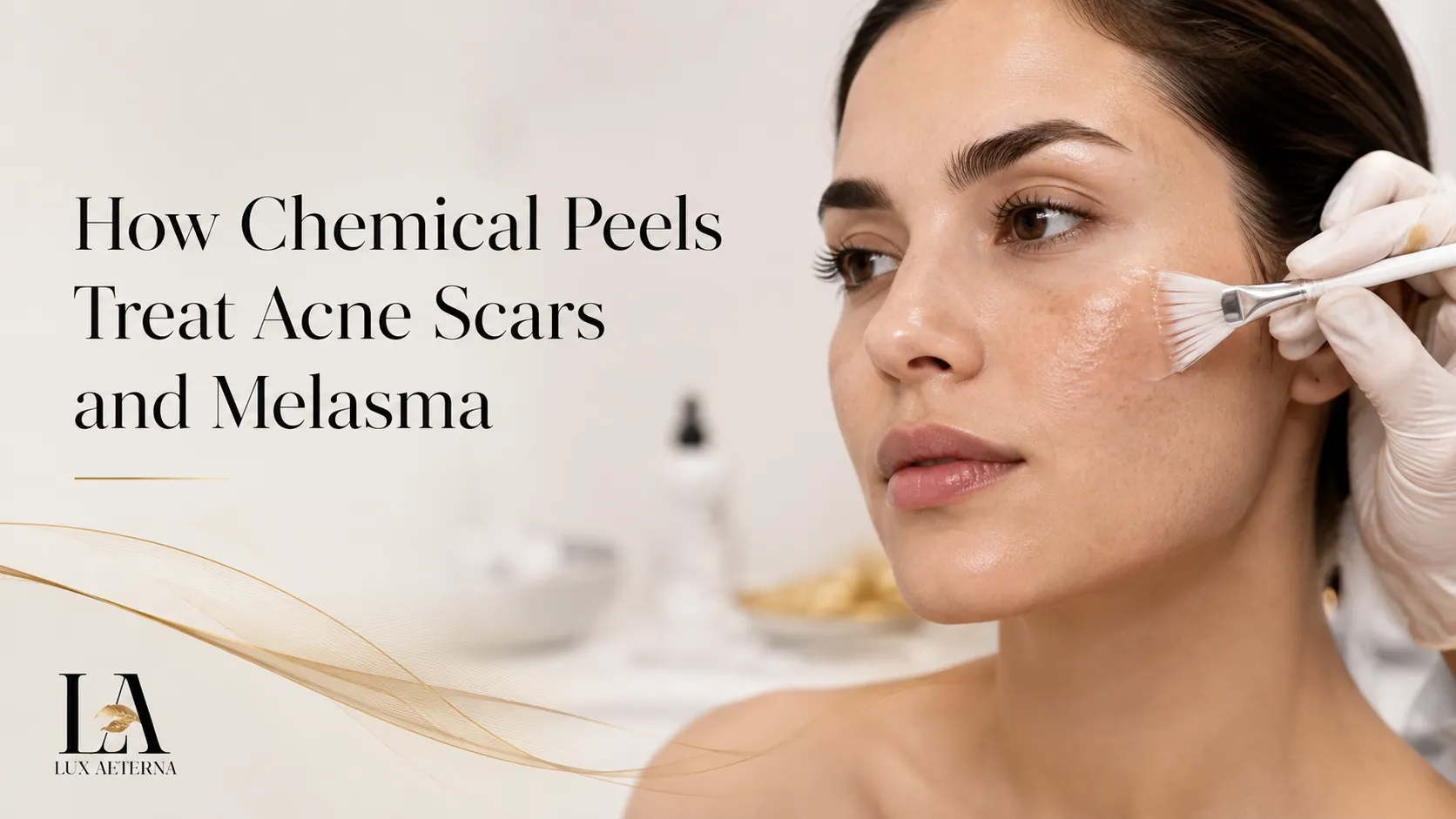
Ask five people what a chemical peel actually does and you’ll get five vague answers about exfoliation and not much beyond that. Which is fair, honestly. It’s not obvious on the surface how acid on your face could help two problems as different as acne scarring and melasma. One is textural damage sitting under the skin. The other is pigmentation that flares with sun and hormones, and one that can just as easily get worse from the wrong treatment as it gets better.
Here’s the short version. A peel isn’t doing the same job in both cases. Basically, it strips away the outer skin layer under controlled conditions, and what happens after that comes down to what’s being treated and how deep the peel goes. With melasma especially, pushing too hard can leave the skin worse off than when you started.
What a Peel Is Actually Doing
The process itself is fairly simple. An acid solution sits on the skin for a set amount of time, and the choice of acid (glycolic, salicylic, TCA) comes down to what’s being treated, since they don’t all act the same way. Underneath that, though, the mechanism is basically identical: it loosens the bonds holding dead, damaged cells together so that outer layer sheds off over the next few days. Fresh skin is left underneath, and that small dose of injury is enough to push the body into producing more collagen and turning over cells faster.
That said, how deep a peel actually goes changes what it can realistically achieve:
- Light peels barely get past the outermost layer. Mostly brightening, mostly refreshing.
- Medium peels reach further into the epidermis and start genuinely affecting texture and pigment.
- Deep peels go deeper still. Real change is possible, but so is real downtime.
Peels rarely work in isolation, either. They’re one option within a wider category of Injectable and Skin Resurfacing Treatments, and which one actually gets recommended usually comes down to what else is going on with the skin.
How Peels Help With Acne Scarring
A peel doesn’t treat every kind of acne scar equally. Icepick and boxcar scars, for example, sit lower than the surrounding skin because there’s tissue actually missing underneath, so smoothing the edges only goes so far. It helps the area around the scar look better, but the dip itself stays put. Filling that in usually means microneedling, laser, or sometimes filler instead.
Where a peel genuinely earns its place:
- Post-inflammatory hyperpigmentation. The flat brown or reddish marks left behind after a breakout. These respond well to repeated exfoliation because it’s discoloration, not structural damage.
- Mild rolling scars and general roughness. These improve gradually, session by session, as repeated peeling encourages fresh collagen underneath.
- Surface-level texture issues. Evened out over time, not fixed in a single visit.
One peel isn’t going to undo years of scarring. Most acne scar removal plans end up combining peels with microneedling, simply because scarring is rarely just one kind of damage at once. Surface change is where a peel is strong, structural change is where it isn’t, and a scar with real depth needs more than a peel to fix.
Melasma Is a Different Animal
Melasma gets talked about like ordinary sun damage, but it isn’t quite that. Sun exposure plays a part, sure, but what’s really happening is that pigment producing cells start overproducing, usually set off by a mix of sun and hormones. The result is patchy brown or grey brown discoloration, typically across the cheeks, forehead, and upper lip.
Peels can help here too, but there’s a lot less room for error:
- Overdo it and the skin can respond by producing even more pigment, right on top of the melasma that was already there. Now you’ve got two problems instead of one.
- People with darker skin tones face a higher chance of this happening, so it’s worth being extra careful in those cases.
- Starting with something gentle, like glycolic or mandelic acid, is generally the safer route.
- Deeper peels get used selectively, and almost never as a first move.
- Sun protection isn’t optional. Skip it and melasma tends to come back regardless of how well the peel itself went.
None of this means melasma shouldn’t be treated. It means it needs to be assessed properly before anyone reaches for a peel.
Scarring Isn’t Only About Acne
People tend to lump scar treatment and acne scar treatment together, but they’re not really the same thing. Surgical scars, injury scars, and scars from other skin conditions each come with their own texture and pigment issues, and a peel can still be useful there too. It’s just that the approach has to shift based on how old the scar is and how deep it runs. A proper treatment plan takes that into account rather than just applying the acne approach to something that was never acne in the first place.
When It Might Not Be Melasma or Acne Scarring at All
Pigmentation and texture changes get misdiagnosed more often than people expect. Sometimes redness or bumps that look like acne, but never actually respond to acne treatment, turn out to be something else altogether. If skin is reacting unpredictably to products, it’s worth getting that looked at before jumping straight into peels. Eczema treatment, for one, is a completely different approach. Eczema can flare up in ways that look a lot like other issues on the surface, but underneath it needs nothing like the same care.
If you’re not sure what you’re dealing with, a proper look from someone doing chemical peel in JLT treatments is a better starting point than guessing.
Frequently Asked Questions
Can one chemical peel get rid of acne scars completely?
Probably not, especially if the scars have any real depth to them. Most people go through a series of sessions, and even then, a peel is going to do more for surface texture than for a scar that dips well below the skin.
Is it safe to use a chemical peel on melasma?
It can be done safely, but the strength and type of peel matter a lot more here than with most other concerns. Go in too aggressively and the pigmentation can get worse instead of better, so melasma generally calls for a slower, gentler approach paired with strict sun protection.
Why does melasma keep coming back after treatment?
Because treating the pigment doesn’t remove what caused it in the first place. Sun and hormonal activity are still there in the background, so without consistent sun protection, melasma has a habit of returning.
How many peel sessions are usually needed?
It varies, but most people need a series spaced a few weeks apart rather than a single visit. Melasma in particular calls for a slower, more conservative pace.
Note: This guide is for general information and doesn’t replace an in-person skin assessment. Melasma and scarring can both be mimicked by other skin conditions, so a proper diagnosis from a qualified practitioner is worth getting first.