


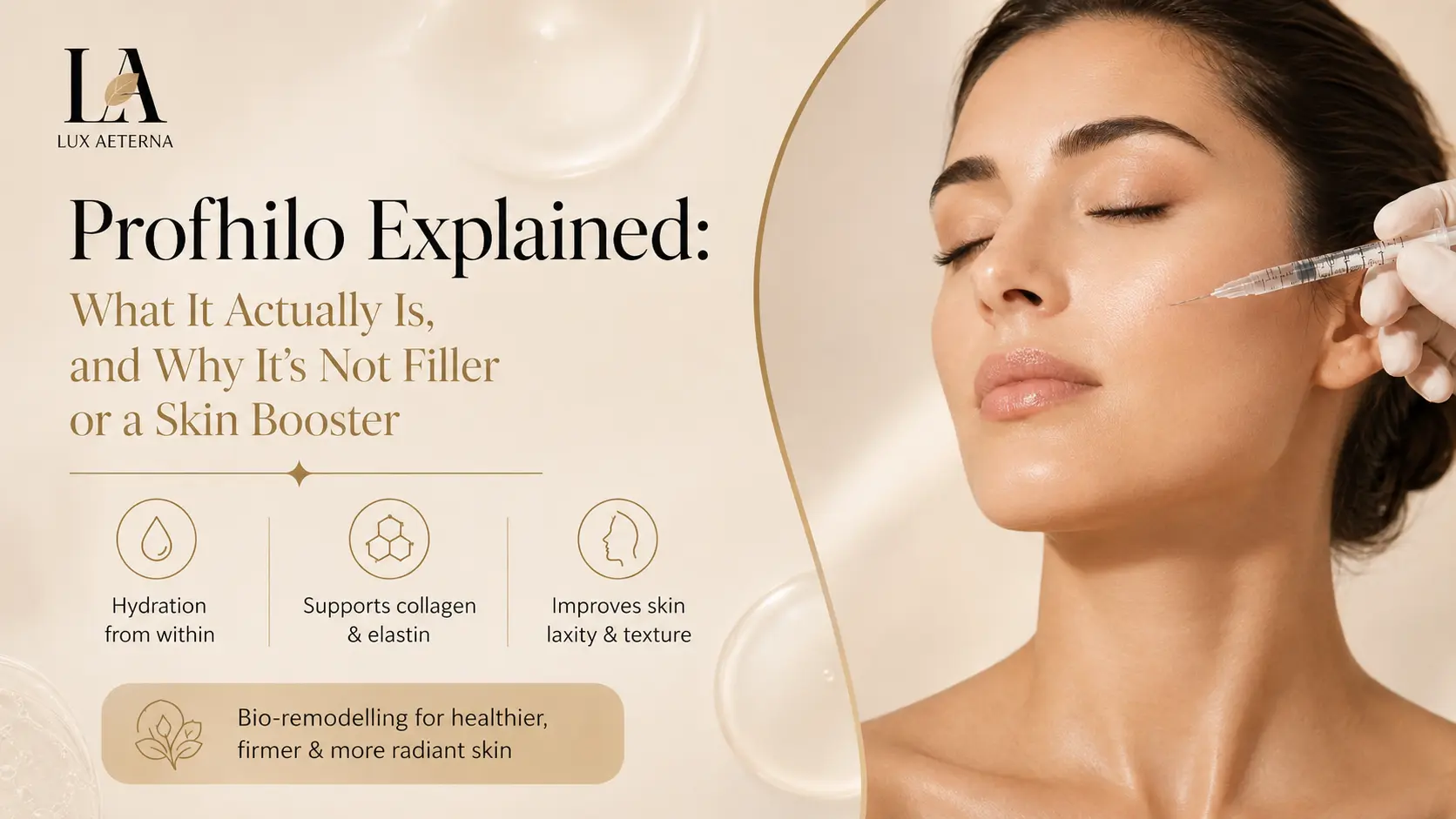
People hear injectable and file Profhilo under filler. Then they hear hyaluronic acid and move it over to skin booster instead. Neither label sticks, and the mix-up isn’t just semantics, it’s the reason some people end up booking the wrong treatment for whatever they’re actually trying to fix.
What Profhilo Actually Is
Profhilo is a highly purified, stabilised form of hyaluronic acid, but the way it’s engineered sets it apart from both filler and standard skin boosters. It’s made through a thermal process that creates a hybrid structure of high and low molecular weight hyaluronic acid, technical-sounding, but what it means in practice is a product that spreads slowly through the tissue after injection instead of staying put where it landed.
Once it’s in, Profhilo doesn’t stay where the needle put it. It moves through the tissue and wakes up several different types of skin cells along the way, fibroblasts and adipocytes among them, and that’s what gets fresh collagen and elastin production going alongside the hydration itself. The term you’ll see thrown around for this is bio-remodelling, and it’s a fair name for it. This isn’t just topping up moisture. Your skin is being pushed to rebuild some of its own scaffolding.
Why It’s Not the Same as Filler
Filler’s job is straightforward, add volume, hold its shape. It’s a denser gel placed precisely where structure is missing, cheeks, lips, under the eyes, and you see the change almost immediately because that’s the entire point of it.
Profhilo does more or less the opposite, on purpose:
- It’s a much thinner product than filler, not built to hold a shape anywhere
- Injections go into just a handful of points, usually five per side of the face, rather than being placed to sculpt a specific contour
- Once it’s in, it’s left to spread through the tissue on its own, not moulded or positioned by the practitioner
- There’s no attempt to add definition to a flat area, that was never the job
Using Profhilo hoping for a filler-like result tends to end in disappointment, not because anything went wrong, but because the two products were never solving the same problem.
Why It’s Not Quite a Skin Booster Either
Here’s where people trip up the most, honestly, because Profhilo and skin boosters do share real similarities. Both rely on hyaluronic acid, both aim to improve how your skin looks and feels rather than reshaping it, and both work from beneath the surface rather than sitting on top of it.
The real difference comes down to concentration and technique:
- Skin boosters use a lower concentration of hyaluronic acid, spread across many small, evenly placed injection points
- They’re mainly aimed at surface-level hydration and glow, not structural change
- Profhilo uses a much higher concentration at far fewer points
- It’s built to tackle skin laxity and crepiness, something a standard skin booster isn’t really designed to address
If dullness or dryness is the main complaint, a skin booster usually makes more sense as a first step. If it’s looseness, sagging, or skin that’s started feeling thinner than it used to, Profhilo tends to be the better call.
Profhilo Isn’t Just for the Face
A lot of people don’t realise Profhilo works just as well on other areas of the body where skin laxity shows up early, the neck, hands, and upper arms in particular. A proper Profhilo Body Treatment in Dubai session typically targets these areas separately from facial treatment, since the skin thickness and laxity patterns differ quite a bit from one region to another.
How It Fits Alongside Other Treatments
Profhilo rarely gets booked on its own. People dealing with looser skin on the body often end up asking about HIFU treatment in Dubai too, since HIFU works at a deeper tissue level using focused ultrasound, tightening from underneath in a way that’s genuinely different from Profhilo’s more surface-focused remodelling effect. The two aren’t competing with each other so much as working on different layers of the same problem.
There’s also a practical reason laser hair removal in Dubai comes up in the same breath as body-area Profhilo. Once hair regrowth is out of the picture, changes in skin texture and tone are simply easier to see day to day, which is why the two get paired fairly often rather than booked as separate, unrelated decisions. Some clinics offer this as part of a wider body hair removal package alongside skin treatments, precisely because smoother skin tends to show off firmness and hydration improvements more clearly than skin still dealing with regrowth or irritation.
Where Profhilo Sits in the Bigger Picture
Profhilo occupies a genuinely specific niche, not quite filler, not quite a skin booster, built for hydration and structural support rather than volume or surface glow alone. Whether it’s actually right for you depends on what your skin’s dealing with, which is really the point of looking through a proper guide to Injectable and Skin Resurfacing Treatments before deciding between the various options rather than picking based on whatever’s trending that month.
Diclaimer: This article is intended for general information only and doesn’t replace an in-person skin assessment. Individual results vary depending on skin condition, age, and treatment history, and should be discussed with a qualified practitioner before starting treatment.