


Walk into five clinics in Dubai and ask what your skin needs, and you’ll probably leave with five different answers. Nobody’s necessarily lying to you. The problem is the language. Skin boosters get lumped in with fillers. Microneedling gets confused with laser resurfacing. Sculptra gets waved off as “just another injectable” by people who’ve clearly never used it, because it barely behaves like one.
This is the plain English version, then. No sales pitch. No nudging you toward a treatment before you actually understand what it does. Just a look at what these treatments are, how they differ, who tends to see good results from each, and what a practitioner is actually weighing before they recommend one over another.
Why Dubai’s Climate Changes the Conversation
Live here longer than a year and you already know your skin isn’t behaving the way it used to wherever you moved from. The sun doesn’t take days off. The air conditioning is basically always on, pulling moisture out of the air whether you notice it or not. Then sandstorm season shows up and adds dust and irritation into the mix. Skin in this climate loses hydration faster than it would somewhere cooler or more humid, and the signs tend to show up earlier than most people expect.
Fine lines and dehydration in the late twenties instead of the mid thirties. A dullness that skincare alone doesn’t seem to fix. Skin that feels tight or flaky indoors, even in people who never had that issue before moving here. Pigmentation from sun exposure that shows up faster and proves harder to shift than it would elsewhere.
Collagen Building Injectables: Sculptra, Profhilo, and Skin Boosters
These three get grouped together constantly, mostly because they’re all injected and none of them give you that instant, obviously “filled” look. Beyond that, they don’t have much in common at all.
Sculptra Builds Slowly, on Purpose
Sculptra is made from poly L lactic acid, a material medicine has used safely for decades. It doesn’t add volume the way a filler does. Instead, it prompts your own fibroblast cells to start producing collagen again, and that’s a slower process by design. Don’t expect much change in the first couple of weeks. That’s not a failed treatment, that’s just how it works. Full results tend to build over several weeks, sometimes a couple of months, as your body does the actual heavy lifting.
It suits people dealing with genuine volume loss more than anyone chasing something quick. Hollow cheeks. Temples that have started to sink in. A jawline that’s lost its definition with age. Because so much rides on how your own body responds, a proper consultation matters here more than with most injectables. A Sculptra treatment in JLT consultation is really the only way to know if you’re a good candidate, since that comes down to your baseline collagen, your age, and what you’re actually hoping to see happen.
Profhilo Handles Hydration, Not Shape
A lot of people assume Profhilo is a filler simply because it’s injected under the skin. It isn’t, and the mix up makes sense but it’s worth clearing up anyway. It’s a stabilised form of hyaluronic acid that spreads through the tissue rather than sitting in one spot, and its main job is deep hydration, with a mild collagen and elastin boost thrown in along the way.
If crepey, lax skin bothers you more than lost volume does, this is usually the better place to start. A Profhilo treatment in JLT often gets recommended before other treatments too, mostly because well hydrated skin tends to respond better to nearly everything you throw at it afterward.
Skin Boosters: The Gentlest Entry Point
Skin boosters sit somewhere between a genuinely good skincare routine and a proper injectable treatment. They’re micro injections of hyaluronic acid placed just under the surface, working on hydration and texture, that “lit from within” quality people mean when they say skin looks healthy instead of done up. Reshaping isn’t part of the job here at all.
A skin booster facial treatment is often where people start when they want a visible improvement without committing to something bigger. Not a bad place to begin if you’re still undecided about injectables in general.
Resurfacing From the Surface Down: Peels and Microneedling
Everything above works underneath the skin. Resurfacing treatments work on top, and they’re solving a different problem entirely. Texture. Scarring. Pigmentation. That dull buildup of dead skin cells that no serum seems able to fix on its own.
Chemical Peels
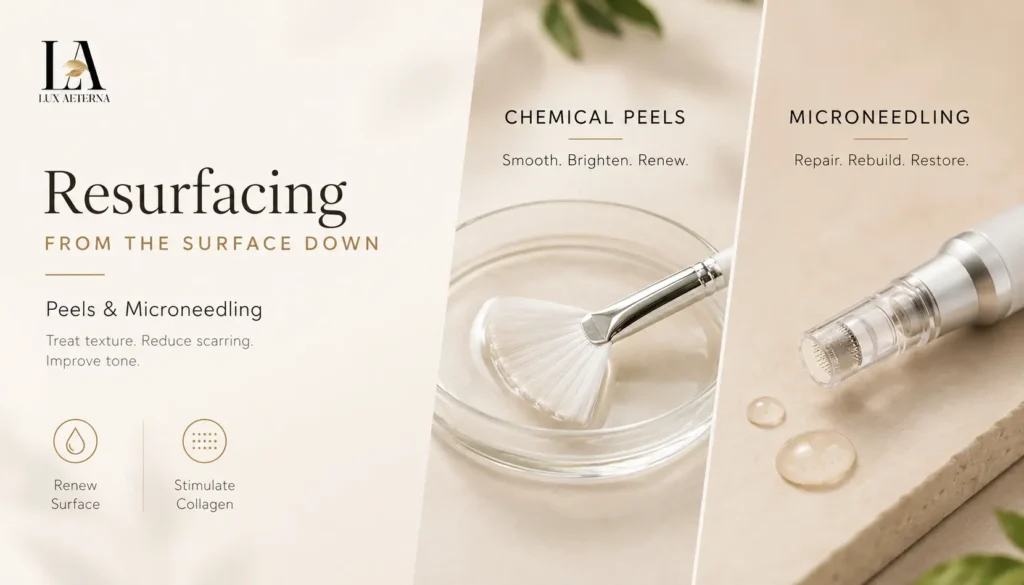
A peel uses controlled exfoliating acids to remove the outer, damaged layer of skin and push cell turnover along underneath it. Strength changes everything about what you should expect. Light peels have almost no downtime and suit dullness or mild texture concerns. Medium peels go further and can meaningfully improve early acne scarring or mild pigmentation. Deep peels give the most noticeable change for pigmentation, acne scarring, and sun damage, but a few days of visible peeling come along with that.
A chemical peel in Dubai has to be matched carefully to your skin type, and that matters more here given the sun exposure. Get the strength or aftercare wrong and you can end up with worse pigmentation than you started with, which is the last thing anyone wants.
Microneedling
Microneedling works on a different mechanism entirely. Fine needles create thousands of tiny, controlled injuries in the skin, which sets off your body’s natural healing response and gets collagen production moving again. It’s one of the more versatile treatments out there, helping with acne scarring, enlarged pores, fine lines and general texture. Results often keep improving for weeks after a single session rather than stopping the day you walk out of the clinic.
Quite a few people pair microneedling in Dubai with skin boosters or targeted serums applied right after the session, since the micro channels the needles create let products absorb far better than they would through intact skin.
If you’re trying to keep it all straight: Sculptra rebuilds structure, Profhilo restores hydration and elasticity, and both take real time to show what they can do. A peel physically removes the damaged surface layer. Microneedling gets your body to repair and rebuild that layer from the inside instead. Skin boosters sit somewhere in the middle of all this, injected but never aimed at volume or shape, just hydration wherever your skin actually needs it.
Aftercare Isn’t an Afterthought Here
It’s easy to treat aftercare instructions as boilerplate you skim past on your way out the door. In a climate this dry and this sunny, though, they often decide whether the treatment was worth doing at all.
Sun protection isn’t optional. Skin is temporarily more sensitive to UV afterward, and even a short unprotected walk can undo weeks of progress, especially after a peel or a microneedling session. Broad spectrum sunscreen, reapplied throughout the day, is part of the treatment. Not an extra step, part of it.
Hydration matters from both directions too. Air conditioning is constantly pulling moisture out of the air, so your skin loses water even when you’re indoors and think you’re safe from the elements. A moisturiser suited to your actual skin type does more than people give it credit for, particularly after Sculptra or Profhilo.
Give heat and heavy sweating a wide berth for the first day or two. Saunas, steam rooms, and intense workouts all increase blood flow to the treated area, which can make swelling or bruising worse right after injectables.
And show up for your follow-ups. Treatments like Sculptra are built as a series, not a one time thing, and skipping later sessions because the first round looked fine is one of the more common reasons people never see the full result they were hoping for.
When It Isn’t Really a Cosmetic Issue
Not everything that shows up on your skin is an ageing or texture concern. Pretending otherwise doesn’t do anyone any favours.
Acne scarring is probably the number one reason people book that first consultation in the first place. And it’s rarely something one treatment sorts out on its own, whatever depth or type you’re dealing with. Most acne scar removal plans end up combining microneedling with peels or other resurfacing methods, since stacking approaches tends to get further than betting everything on a single one.
Melasma is where the climate genuinely works against you. It shows up as patchy brown or grey brown pigmentation that flares with sun exposure and hormonal shifts, and a proper melasma treatment in Dubai plan almost always pairs strict sun protection with targeted treatment. Pigmentation left unmanaged by real sun avoidance tends to just come back, no matter how good the initial treatment was.
Rosacea causes persistent redness, visible blood vessels, and sometimes small bumps that get mistaken for acne but respond to a completely different approach. Heat and sun are known triggers, which makes rosacea treatment in Dubai especially relevant given where we live. Treat it like ordinary acne and there’s a good chance you make it worse, not better.
Eczema is a different animal altogether. It’s not about pigmentation or blood vessels, it comes down to a compromised skin barrier and inflammation underneath it. The tricky part is that eczema, rosacea, and a plain allergic reaction can all look pretty similar from the outside, so getting the diagnosis right actually matters more than rushing into treatment. That overlap is exactly why eczema treatment in Dubai so often gets paired with proper allergy diagnostics in Dubai. What looks like a textbook eczema flare sometimes turns out to be your skin reacting to something else entirely, a new product, something in your diet, even the water.
Hair thinning gets treated as purely genetic more often than it should be. Stress, climate, nutrient gaps, and hormonal shifts all play a role too, especially for anyone who’s relocated somewhere hot and dry more recently. Hair loss treatment in Dubai usually starts by identifying the actual cause before settling on a protocol, since treating pattern hair loss the same way you’d treat stress related shedding rarely works out well.
Moles deserve their own mention, kept separate from anything cosmetic. Any mole that’s changed in size, shape, or colour, or simply looks different from the others on your body, is worth having checked. A mole check-up in Dubai takes a few minutes, doesn’t hurt, and can catch changes early, well before they turn into something more serious. Don’t let this slide down the list in favour of something more cosmetic.
So, How Do You Actually Decide?
There’s no single right answer here, and anyone who hands you one without looking at your skin first isn’t being straight with you. As a rough starting point, though.
Volume loss from ageing tends to point toward Sculptra. Hydration, laxity, or crepey texture usually points toward Profhilo or a skin booster instead. Texture, scarring, or general dullness is better addressed directly with a chemical peel or microneedling. And persistent redness, patchy pigmentation, or an unexplained rash belongs in a dermatology conversation first, not a cosmetic one, however tempting it is to just book an injectable and hope for the best.
Most people, once they’ve been through a proper consultation, end up combining more than one of these over time. That’s normal. It’s not a sign something went wrong the first time around. Skin rarely has just one thing going on with it.
A routine built for London or Toronto just doesn’t account for the extra barrier repair this climate demands. That’s a big part of why working with a wellness clinic in JLT that treats skin as one connected system, instead of chasing whatever’s trending that month, tends to hold up better over time.
Frequently Asked Questions
How long does something like Sculptra actually take to show results?
The mechanism is about kickstarting your own collagen, not adding volume on the spot, so there’s no overnight transformation here. Somewhere around six to eight weeks is when most people start seeing it show up, and things keep building from that point over the next few months.
Are skin boosters basically the same thing as dermal fillers?
No, and it’s probably the most common mix up in this whole category. Fillers add volume and reshape specific areas. Skin boosters improve hydration and overall skin quality without changing the shape of anything.
Can a chemical peel and microneedling be done in the same appointment?
Usually not. They tend to get spaced apart rather than stacked together, since both leave skin more sensitive than normal for a while afterward. A practitioner will typically work out a sequence based on what you’re actually trying to fix.
How do you know if something is cosmetic or if it actually needs a dermatologist?
If a concern is new, changing, itchy, painful, or spreading, get it properly assessed instead of guessing at home. Rosacea, eczema, and allergic reactions in particular can look nearly identical on the surface while needing very different treatment underneath.
Is it normal to need more than one type of treatment?
Yes, more often than not, honestly. Most skin concerns have more than one thing driving them, so a combined approach built around your actual skin, rather than whatever happens to be trending, tends to hold up better in the long run.
Note: This guide is intended for general information and doesn’t replace an in person skin assessment. If you’re dealing with a persistent or changing skin concern, a consultation with a qualified dermatologist or aesthetic practitioner is the sensible next step.