


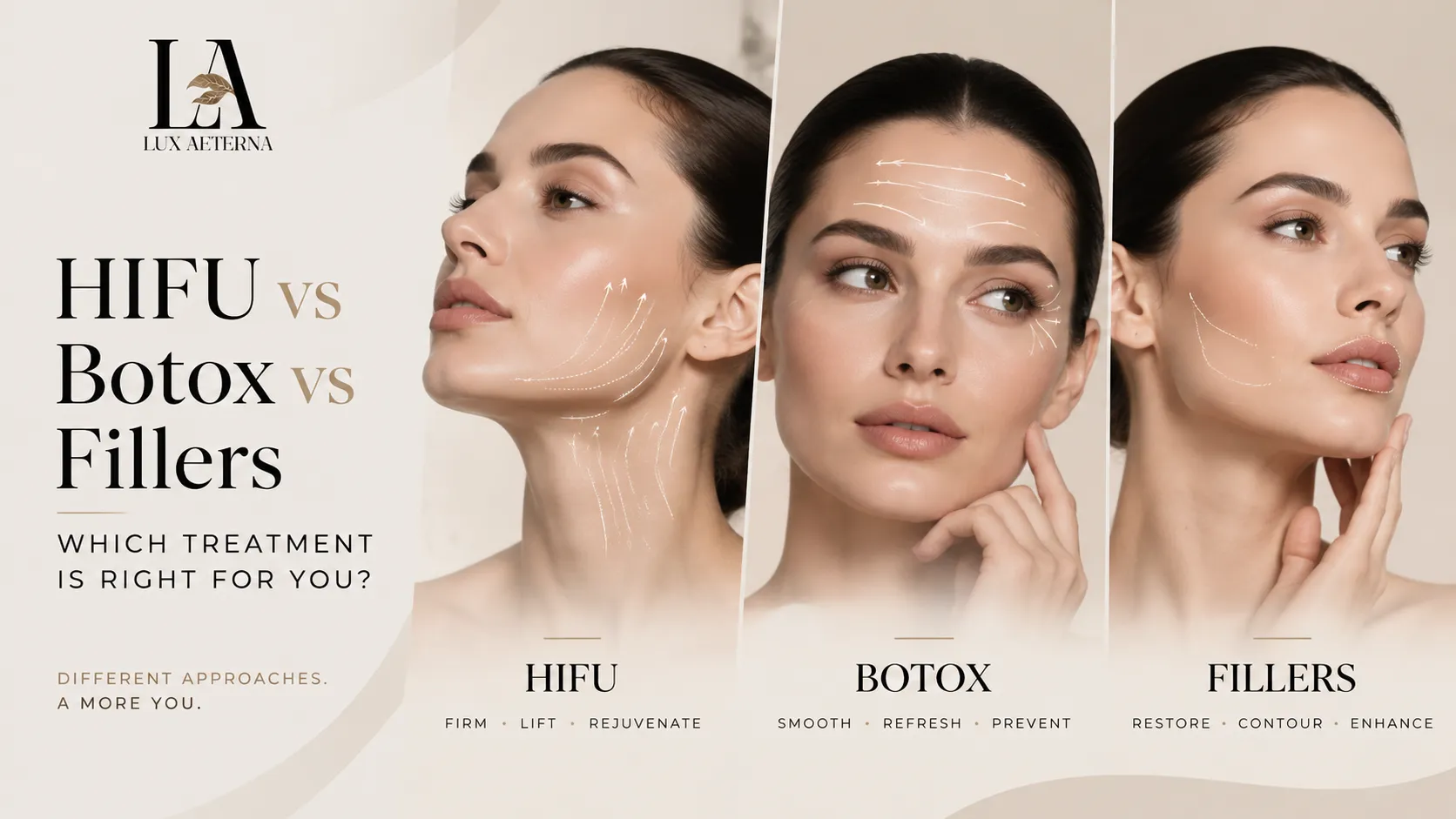
HIFU. Botox. Fillers. Say them enough times in one conversation and people start treating them like interchangeable options, three roads to the same destination. They’re not. Each one’s fixing a completely different problem, and once you actually get that, choosing between them stops feeling like a coin flip.
They’re Not Competing, They’re Solving Different Things
Simplest breakdown there is. HIFU’s about firmness. Botox is about muscle movement. Fillers are about volume. Drop the “which one’s better” question entirely and ask yourself “what am I actually trying to fix” instead. The answer usually falls into place on its own.
- HIFU handles early sagging by working underneath the surface
- Botox softens expression lines by calming down the muscles causing them
- Dermal fillers bring back volume that’s gone missing in specific spots
1. HIFU: For Firmness and Early Sagging
HIFU, high intensity focused ultrasound if you want the full name, goes to work below the skin’s surface, hitting deeper layers to get collagen production going and support natural firmness. It’s the non-surgical route for anyone noticing early sagging, jawline, neck, cheeks, who isn’t looking to go under the knife over it.
Key points about HIFU treatment:
- Works by stimulating the skin’s own collagen production
- Results build gradually over several weeks rather than showing up overnight
- Commonly used on the jawline, neck, and cheeks
- Well suited to people who want a firmer, lifted look without changing muscle movement or facial volume
2. Botox: For Expression Lines
Botox works completely differently. It’s a muscle relaxant, used specifically to soften the fine lines that form from repeated facial expressions, forehead lines, crow’s feet, the area between the brows. Unlike HIFU, there’s no lifting or added volume happening here. It’s purely about dialing down the muscle movement responsible for those lines showing up, which over time softens how visible they are.
A few things worth knowing about Botox treatment:
- Targets muscle movement rather than skin structure or volume
- Most commonly used on forehead lines, crow’s feet, and frown lines
- Results typically show within several days
- Effects generally stick around for a few months before another session is needed to keep things looking fresh
3. Dermal Fillers: For Volume and Contour
Volume just fades with age, no real way around it. Cheeks, under the eyes, lips, all spots that quietly lose their fullness over time without anyone really noticing until it’s already happened. Fillers bring that back, usually hyaluronic acid based, and they’re not limited to just restoring what’s gone either, they can shape or refine an area too if that’s what someone’s after.
A few things worth knowing about dermal fillers treatment:
- Volume comes back, muscle movement and skin firmness stay untouched
- Cheeks, lips, and under-eye hollows are where they get used most
- Results are visible almost immediately after treatment
- Longevity depends on the product used and the area treated
How They Stack Up Side By Side
| HIFU | Botox | Dermal Fillers | |
| What it targets | Firmness and laxity | Muscle movement and expression lines | Volume and contour |
| How it works | Ultrasound to get collagen going | Relaxes the muscles causing lines | Adds volume beneath the skin |
| When results show | Gradually, over several weeks | Within a few days | Almost immediately |
| Best suited for | Early sagging, jawline and neck firmness | Forehead lines, crow’s feet, frown lines | Cheeks, lips, under-eye hollows |
| Downtime | Minimal | Minimal | Minimal, some temporary swelling possible |
Can They Be Combined?
Actually pretty common, yeah. A lot of treatment plans end up using more than one of these since they’re each solving something separate rather than stepping on each other’s toes. Some combinations people go for:
- Botox for expression lines paired with fillers for cheek or lip volume
- HIFU for firmness paired with fillers for contour and volume
- All three used together as part of a broader, phased treatment plan
We tend to see patients start with one treatment, then add another in once they get a feel for how their skin’s actually responding, rather than jumping into a full combination on day one. Honestly, a proper consultation is still the easiest way to land on whatever approach, or mix of treatments, fits your specific goals.
Why the Right Assessment Matters
No two jawlines are identical. Same goes for expression lines. Something that works wonders on one face might do close to nothing on another, and that’s exactly the reason skipping a consultation trips people up so often. Our practitioners typically spend the first part of any consultation just understanding what’s actually changed for you, sagging, lines, lost volume, before recommending anything, since guessing based on a trend or what worked for a friend rarely gets the right result.
Frequently Asked Questions
Can I get HIFU, Botox, and fillers all in one visit?
Sometimes, really depends on which areas you’re treating and what your practitioner thinks makes sense. Plenty of people combine these across separate visits, some do it in the same session. Worth bringing up during consultation rather than assuming either way.
Which one lasts the longest?
Depends on which you’re asking about. Botox usually runs three to four months. Fillers can stretch anywhere from six months to over a year, depending on the product and where it’s placed. HIFU builds slower but tends to stick around longer since it’s working through your own collagen, though a maintenance session here and there keeps things going.
Is any of these more painful than the others?
Not really, all three are handled fine by most people, and clinics generally offer numbing if you want it. Everyone’s sensitivity is a bit different, but none of these are known for being particularly uncomfortable.
Do I have to commit to just one, or can my plan shift later?
It can absolutely shift. A lot of people start with one treatment and layer on others once they figure out what they actually want. A decent practitioner checks back in with you at each visit instead of locking you into whatever you picked on day one.
How do I actually figure out which one’s right for me?
Consultation, honestly, there’s no shortcut around it. Since each one’s solving something different, firmness, muscle movement, volume, getting your specific skin and goals looked at properly beats guessing based on what worked for someone else’s face.
This article is for general informational purposes only and isn’t a substitute for professional medical advice. Individual results vary, and a qualified practitioner should assess your skin and goals before recommending any treatment.